the brief.
Liquid Agency brought Akamai a bold idea: stop explaining security and start telling a story about it, in a place called the Domain, with characters an audience would follow. Concept and creative direction are theirs. We came in alongside them to make that world real, and to make it real in a way that could survive being filmed again, and again, and again.
Akamai’s own positioning spans every API, from legacy to AI, and the number behind it is blunt: 87% of organizations had an API security incident in the past year. The threat is real, expensive, and completely invisible, until it isn’t.
Invisible is the marketing problem. You cannot photograph an API. The category’s standing answer is the explainer video, the analyst webinar, and the product demo, which is how a brand ends up publishing over a thousand videos and still not having an audience. Akamai had plenty of assets. What they wanted was an audience that came back.
The harder version sits underneath. Akamai does not sell one product. API Security, Guardicore Segmentation, and Workforce Protector each solve a different failure, and each would normally get its own campaign, its own creative, and its own audience built from scratch. Three campaigns competing for the same buyer’s attention is how a portfolio fragments itself. Liquid’s answer was a single world big enough to hold all of it.
the challenge.
A world is easy to describe but expensive to build. Floating towers, glowing skyways, a cast of robot characters with real personality, an attacker with a silhouette you recognise in one frame. That is a feature-animation brief, and it arrived attached to a marketing schedule.
The format was the other risk. A recurring cast, a persistent world, and cinematic production values are how television gets made. In B2B content the second episode has never been affordable, which is why the ambitious campaign in this category almost always ends up as one hero film and a sizzle reel. Whatever we built had to be reusable by design, or the series would die at episode one.
the process.
ten days of looking.
The Domain took ten working days to define. Around eight hundred rendered concept illustrations by the end of it. One hundred and twenty passes at a single tower before the skyline was right. Thirty-nine at the attacker before his character confirmed.
why eight hundred.
Almost none of it shipped. That is the point. Eight hundred concept illustrations exist so that a few dozen could be chosen, and the choosing is where the work is. Art direction was settled by putting moodboards against each other and picking one. A whole line of exploration was killed on a stated principle, that humanoid androids standing in for APIs would slide into the uncanny valley, and the design pulled back toward something rounder and friendlier. The score was auditioned the same way, a first choice and a runner-up, before a note was locked.
designing for episode two and beyond.
A character sheet with a height comparison and a coded file name means that the characters who appear in the next episodes are the same consistent characters, prompted by someone else, months later. Akamai and Liquid wrote a world with recurring characters and sets. Our job was to make those characters reproducible, so the second episode started from a system instead of starting over.
the crew.
A series director ran it. Johnny Darrell has spent his career directing animated series, and on the Domain he did the job he would do on any of them: set the pace, block the shots, and cut the picture. Beside him, a producer with twenty years in animated and CG series kept a schedule that had to behave like television rather than like a campaign.
The rest of the crew was hired for the places generative models give out. Generated audio arrives thin, so a sound effects artist built on top of it until the world had weight and space. Shots no model will hold went to a VFX artist and were finished in After Effects. A colourist graded the series end to end, so separately generated sequences read as one place, lit by one hand.
This was not a prompt queue with a deadline attached. It was staffed the way a television series is staffed, and every judgement that mattered was made by someone who had made it before.
the economics.
Generative production is what makes a search that wide affordable. It buys volume. Everything that matters after that is taste.
the solution.
the world.
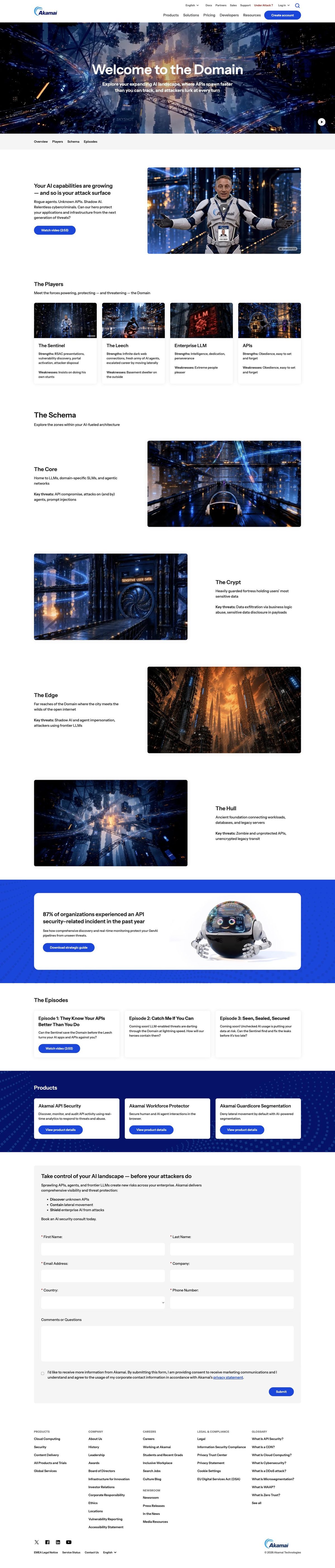
A city with floating towers and glowing API skyways, a fortified vault marked SENSITIVE USER DATA, and little API characters scurrying across the ramps, one of them falling off with a Wilhelm scream. The setting carries the technical exposition so the dialogue does not have to. The architectural reference was The Line, the mirrored linear megacity in the Saudi desert. The look landed somewhere clean, bright, and legible at speed, which matters when a shot is on screen for two seconds.
the cast.
The hero is not an invented character. He is one of Akamai’s own security directors, who taps his watch, falls through a portal in the office wall, and arrives in the Domain with his suit already changed. Putting a real subject matter expert inside the armour is what keeps the fiction anchored, and he oversells every win. The attacker and his hovercraft swarm work the other side. The API androids are round, cute, and doomed, which is most of why the tone works. Each new product brings a new character into the world rather than a new deck of talking points.
the episodes.
The first, “They Know Your APIs Better Than You Do,” is API Security: forgotten endpoints, a prompt injection that corrupts an LLM tower, and an attacker who discovers every API around him is already shielded. “Catch Me If You Can” follows, with LLM-enabled threats moving through the Domain faster than anyone can track them. Then “Seen, Sealed, Secured,” where unchecked AI usage is leaking data and the Sentinel has to find it before it costs someone.
the connective tissue.
Running gags carry between episodes. A tag after the endcard plants the next one inside the story, so the series pulls itself forward rather than relying on a content calendar. Even the dramatization disclaimer is in on it, read out by a very patient British woman: “Akamai security products are highly customizable and built to scale. Manual intervention by superheroes is not currently supported.”
the outcome.
Akamai gave episode one its own landing page. The fiction became the campaign’s architecture: the characters, the four territories of the Domain, and the episode titles all carry through to the product pages and the calls to action.
The world extended. Further episodes are written, each one carrying a different product in the security portfolio, each handing off to the next inside the story itself. An enterprise client continuing a series across product lines is the outcome that matters here, because it means the format earned the next one.