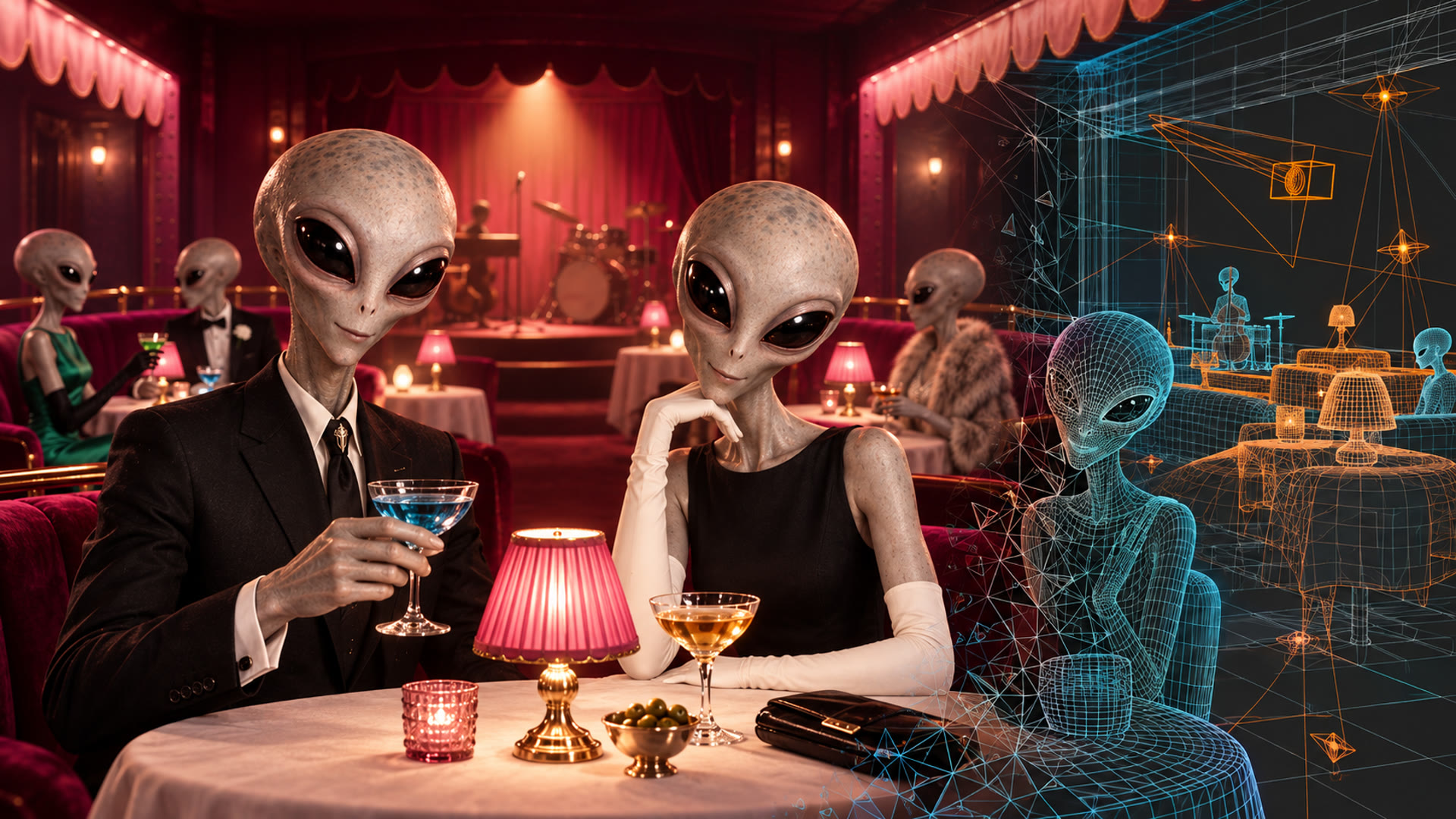
Henry Hill walks Karen across the street, past the line, and in through the service door of the Copacabana.
They go down the stairs, along the corridor and through the kitchen, and come out in the club, where a table appears from nowhere right at the foot of the stage.
It's one take with no cuts. Scorsese and Michael Ballhaus did it in 1990 with a Steadicam and a lot of rehearsal.
It's also one of the most studied shots in cinema, and I wanted to see if an agent could take it apart and put it back together, this time with grey aliens on a spaceship.
The slop problem hasn't gone anywhere
For the past year, a lot of what we do at Power Shifter Studios comes down to getting more out of the video and image generators while getting less slop out of them.
The models keep getting better and the shots keep getting longer, but the slop problem just hasn't gone away.
So we keep experimenting with how we prompt.
We ran JSON prompts for a couple of months. That didn't last, because most of the people on a film crew are not coders and shouldn't have to be.
We tried animatics, and we tried bringing static storyboards to life.
Then MCP arrived, which lets Claude drive other software directly. You describe what you want and it does the clicking.
Recently Higgsfield built a bridge that puts Claude right inside Blender, a 3D application that is famously hard to learn. Now you can block out a scene with low-poly characters, rough sets and real camera moves, just detailed enough to work out how the shot moves and what everyone in it does.
That matters because of what video models are good at.
They reference stills and footage very well, and it turns out they reference rough 3D renders extremely well. Hand a model a low-poly previs and it will match the timing, the pacing, the camera angles and the movement almost beat for beat.
Hand a model a low-poly previs and it will match the timing, the pacing and the camera almost beat for beat.
So I had a question I hadn't seen anyone else answer yet. Could an agent run the whole idea backwards?
Taking the shot apart
I gave Claude the Copa clip and asked it to watch.
I wanted it to work out where the walls are, how far the camera travels and when it turns, who is standing where at which second, and what they do as the camera slides past them.
The whole setup ran from a single Claude session. Higgsfield's MCP server handled image and video generation, and the Blender bridge handled sets, characters and camera. I directed it from my trailer.
Claude built all of it in Blender through the bridge: a floor plan of the whole route, a camera path matched to the original shot, and stand-in bodies for every key character, each with a mark to hit at the exact moment it needs to hit it.
Then I rendered what I call a three-up. An overhead isometric map of the route sits on top, the previs camera travels through the sets in the middle, and the original film plays on the bottom, all three running to the same clock.
That three-up went back in as the reference video for every generation that followed.
This is the part I'd underline.
The moment there was a real set, real characters and a real camera move to map to, everything downstream got easier, including the set plates and the character sheets.
Experiments like this one land in the newsletter before they land anywhere else. The Signal ships what we're learning — monthly, short, no filler.
Building the world before shooting in it
Two more things had to exist before any filmmaking could start.
The first was fifteen environment plates, generated off the reconstruction. Every corridor, every corner of the galley, the pass and the vestibule went into the reference stack, so the model stops inventing a new set every time the camera turns a corner.
The second was twenty-five character sheets, front, side and back with wardrobe, for every alien who has a line or a piece of business.
That left a math problem. We had forty references and the video model takes about nine per request, so the sheets had to be combined into strips before anything could be generated.
From there Claude built the characters and the sets and started generating shots.
The shot had to be broken into three pieces. The video model caps out at thirty seconds, and past about fifteen the drift is too much to live with no matter what you do.
What broke
It didn't all go to plan, and I did have to re-render some shots.
The timing was fine and the sets were fine. The trouble came at the end of the long takes, after the camera had already done a lot of complicated work, and it showed up in the people.
Gino rendered as a human in a pink suit. The fix was naming him as a grey alien in his own line of the prompt, not just on his sheet.
The fixer handed money to a cashier and his arm went straight through her body. We restaged it with a piece of blocking that can't go wrong, where she leans back and he reaches across in front of her.
An alien slid down the corridor without moving his feet. That one needed a physics clause about solid bodies and visible steps.
And the chef vaulted over the stove to shake hands, because the word lunges was in the prompt. The model will take you at your word.
The stubborn one was the geometry. With all those corners, turns and doorways, the model kept cross-fading between rooms instead of walking through them. Describing the set as one continuous corridor helped, but a few of those dissolves are still in the final cut and I couldn't fix them.
I left the mistakes in. A highlight reel teaches you nothing, and if I only showed you the six seconds that worked, you'd be right not to believe me.
A highlight reel teaches you nothing.
What this means for an agency brief
Clients hand agencies a reference film all the time, usually with the words "make it feel like this." This is that workflow. The reference becomes a 3D previs with the blocking, the camera and the timing worked out before anyone spends production money.
The reference becomes a 3D previs with the blocking, the camera and the timing worked out before anyone spends production money.
The floor plan and the three-up are things a client can sign off on. Blocking and camera get approved first, and the expensive part comes after.
The sets, the cast sheets and the camera path are all reusable. When the client changes their mind, we re-render the shot that changed instead of starting again, and the characters still look like themselves.
Know the limits going in. Clean shots run about fifteen seconds before drift sets in, which is plenty for a :15 or a :30 built from a few shots. A long unbroken take like the Copa still needs stitching, and you'll see the seams.
A word for your legal team, too. I used Goodfellas as a study of how a shot is built. For client work, the reconstruction starts from your board, not someone else's film.
The idea and the creative direction stay with the agency. We're the production team that gets it made.
What twelve takes taught me
Twelve takes across three shots got me to the finished piece, and four rules came out of them.
- Reconstruct the set before you generate. The reference video built off that reconstruction does more than any prompt wording.
- Any character who acts needs their own full sheet. A face inside a strip keeps them the right species, but it doesn't make them the one who acts.
- Describe the set as one continuous space, never as a list of locations.
- Never write lunge, leap or spring for a background character.
Why this is the interesting part
The aliens were a bit of fun, but the pipeline underneath them is what I'd want you to take away.
For most of the last two years, generative video has been a slot machine. You pull the lever, hope, and pull it again. The best fix for slop I've found so far is giving the model something to follow: a set it can't redecorate, a camera path it can't improvise, and a cast that stands on its marks.
The best fix for slop I've found so far is giving the model something to follow.
Claude did the reconstruction, the Blender build, the plates, the sheets and every generation. My job was to watch takes and call what was wrong. That arm went through her body. That's a dissolve where a walk should be. He's gliding.
That's continuity and coverage, which is first AD work, and it's a hundred years old.
I think the people who are going to be good at this are the ones who already know how to run a set. Most of them haven't figured that out yet.
If you're sitting on a board you were told was unshootable, bring it to us at Power Shifter Studios.